Duel with Bernajoux
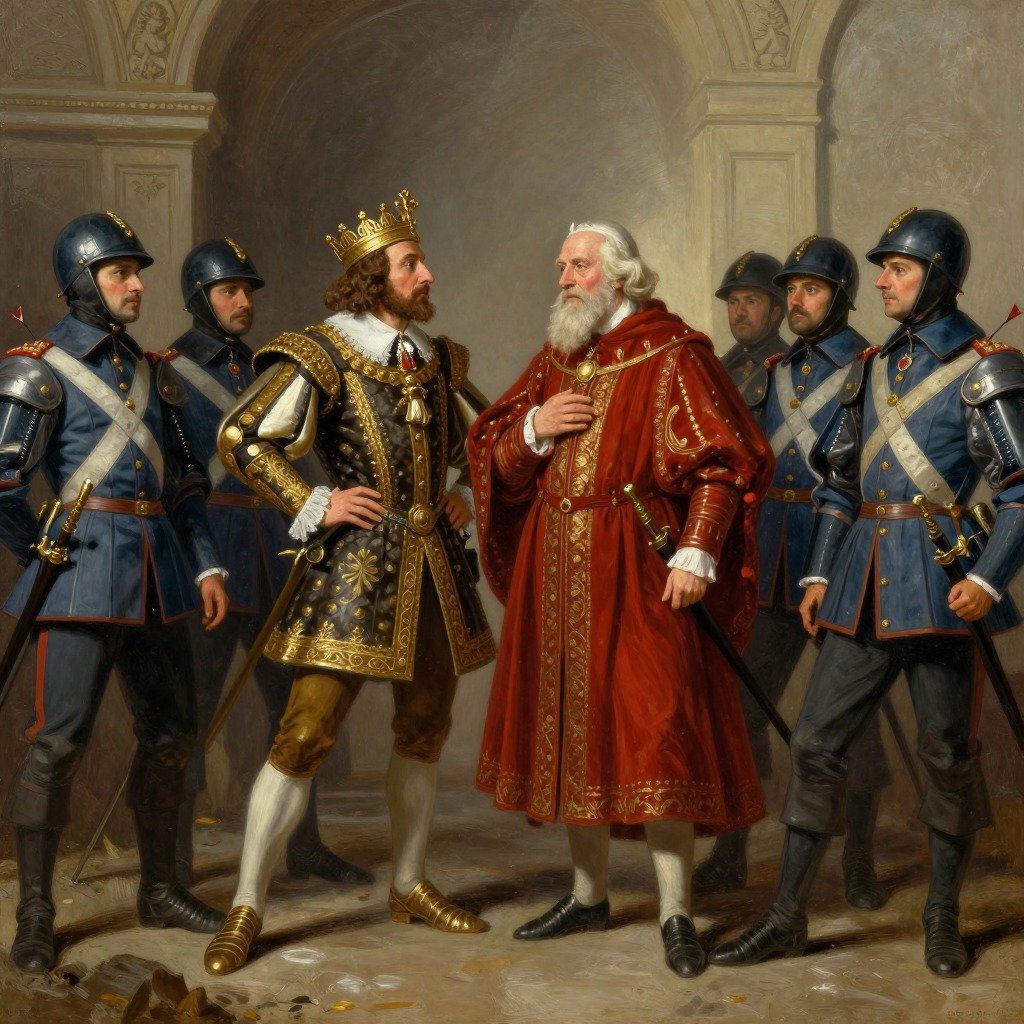
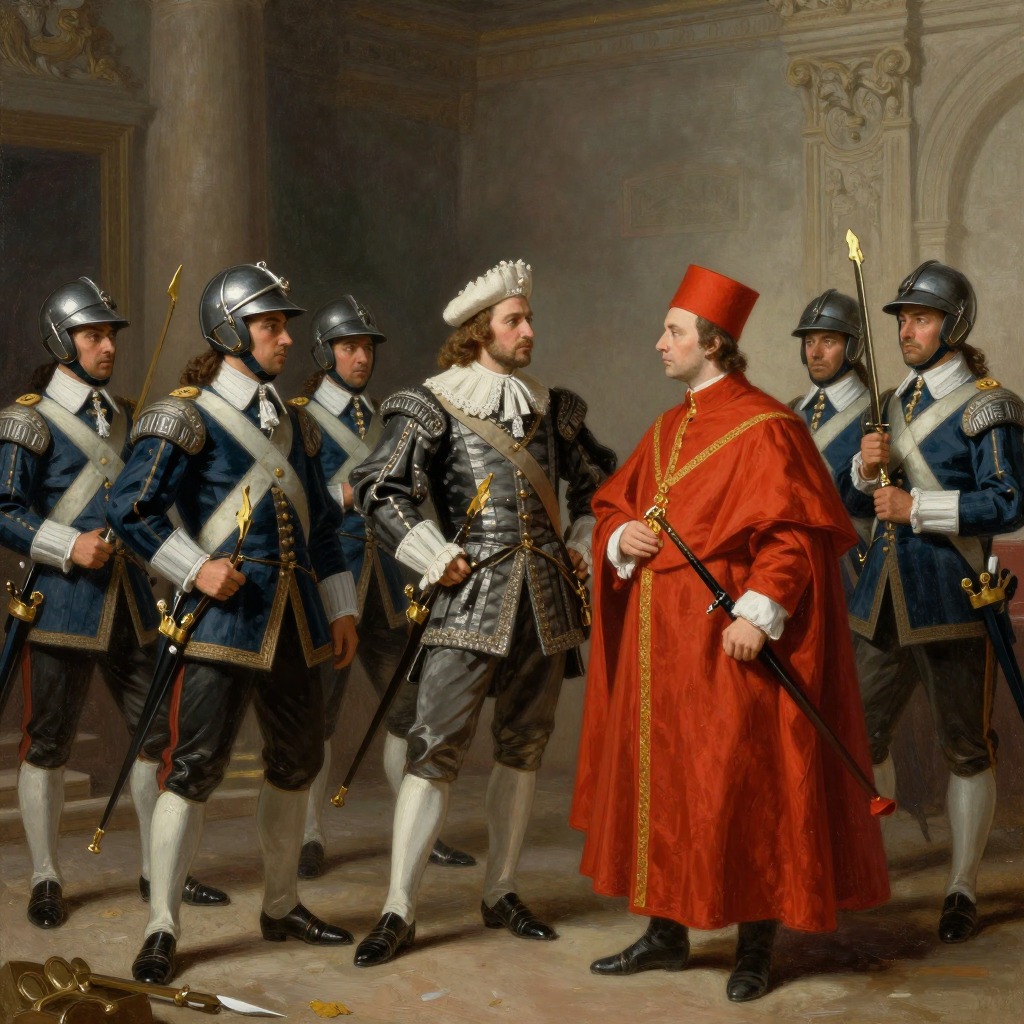
The Duel with Bernajoux marks a decisive turning point in d'Artagnan's early career, transforming him from a promising but untested Guardsman into a recognized figure at court. The confrontation, which began as a casual insult at a tennis court, rapidly escalated into a full-scale street battle involving the Musketeers, the Cardinal's Guards, and the household of the Duc de la Tremouille. The affair not only cemented d'Artagnan's reputation for courage and skill but also brought him—along with Athos, Porthos, and Aramis—before King Louis XIII, who rewarded him with forty pistoles and set him on the path toward his coveted commission in the Musketeers.
Causes and Background
The duel was rooted in the simmering rivalry between the King's Musketeers and the Cardinal's Guards, a conflict that had already produced several violent encounters. D'Artagnan, still a Guardsman in the company of Monsieur Dessessart, had been invited by Athos, Porthos, and Aramis to play tennis at a court near the Luxembourg stables. During the game, a Guardsman of the Cardinal named Bernajoux, still smarting from the defeat of his comrades in the earlier battle at the Carmes-Deschaux, saw an opportunity for revenge. He remarked loudly to a companion that it was "not astonishing that that young man should be afraid of a ball, for he is doubtless a Musketeer apprentice." D'Artagnan, who had been sitting in the gallery after withdrawing from the game, heard the insult and immediately challenged Bernajoux. The Guardsman, confident in his reputation as one of the most feared swordsmen in the cardinal's service, accepted, and the two agreed to meet outside the tennis court.
The Duel and Its Escalation
Once in the street, d'Artagnan pressed for an immediate fight, citing his appointment at the Louvre at midday. Bernajoux, a seasoned duelist, initially suggested a more secluded location, but d'Artagnan insisted. The two crossed swords, and within moments d'Artagnan, fresh from his victory over Jussac, wounded Bernajoux in the shoulder. The Guardsman, refusing to yield, rushed blindly forward and impaled himself on d'Artagnan's sword. As Bernajoux staggered toward the Hotel de la Tremouille, where he had a relative, two of his friends from the tennis court rushed out, swords drawn, to attack d'Artagnan. Athos, Porthos, and Aramis immediately intervened, driving them back. The cry "To the rescue! The Hotel de la Tremouille!" brought out the household's servants and guards, while the Musketeers shouted "To the rescue, Musketeers!" The brawl quickly became a general melee, with soldiers from other companies joining the Musketeers out of their shared hatred for the cardinal. The fighting was intense, and the Musketeers and their allies were on the verge of setting fire to the hotel when eleven o'clock struck, reminding d'Artagnan and his friends of their audience with the king. They calmed their comrades and hurried to M. de Treville, who immediately led them to the Louvre.
Consequences and Aftermath
The duel had far-reaching consequences. M. de Treville, informed of the fresh disturbance, took the four young men to the Louvre, but the king had gone hunting. The cardinal, however, had already spoken to the king, and Louis XIII was initially angry. Treville skillfully managed the situation, arranging for the wounded Bernajoux to be interrogated by the Duc de la Tremouille himself. Bernajoux, placed between life and death, told the truth: the fault lay with his own people. The duke apologized to Treville, and the king, now satisfied, received the four friends. D'Artagnan, who had wounded Jussac the day before and now Bernajoux, was singled out by the king, who gave him forty pistoles as a reward. More importantly, the king ordered that d'Artagnan be placed in the company of the Guards of Monsieur Dessessart, with the promise of eventual entry into the Musketeers. The cardinal, furious at the loss of seven of his best men in two days, absented himself from the king's gaming table for eight days, while the king mockingly inquired after the health of Jussac and Bernajoux. For d'Artagnan, the duel was the final proof of his worth, earning him the king's favor and setting the stage for his future adventures.